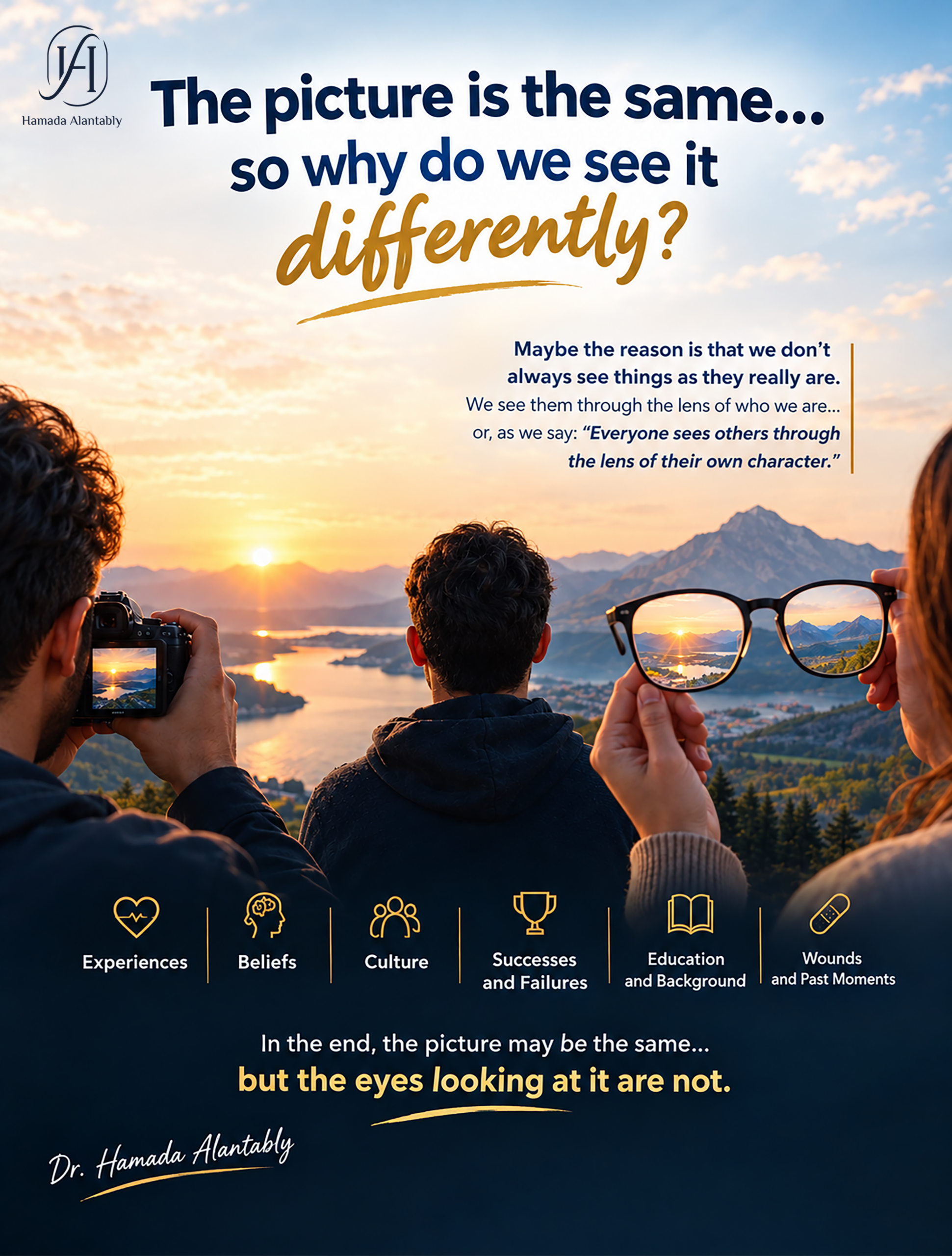
Maybe the reason is that we don’t always see things as they really are. We see them through the lens of who we are… or, as we say in Arabic, “Everyone sees others through the lens of their own character.” Put more simply: a decent person tends to see decency in others, while a dishonest person may suspect everyone of being dishonest.
We don’t see the world through our eyes alone. We see it through our experiences, beliefs, culture, successes and failures, and even through the wounds left by certain moments in our lives. That is why two people can stand in front of the same scene, see the same thing, and still walk away with completely different perceptions… because each of us does not simply see the picture; we see it through the lens that life has shaped within us.
We can see this quite clearly when we travel. Two people may visit the same country, yet one comes back saying, “It was full of breathtaking landscapes, wonderful people, places of worship, and beautiful experiences.” The other may come back saying, “It was all about nightlife, dancing, and moral decline.” They were both in the same country. They saw the same streets, places, and people… but what differed was not the place itself. It was the eyes through which each person looked at it, and what each person was looking for.
And it doesn’t stop there. Even in areas of knowledge that we assume should be objective and fixed, our understanding and interpretation can differ depending on the school of thought or methodology we follow. Take quality, for example. At first glance, it may seem like something clear and objective, yet even quality can be viewed from different perspectives.
There is a well-known idea attributed to Siemens that its measure of quality is simple: the customer should come back, not the product. It is a simple statement, but it carries a deeper meaning. Quality is no longer just a specification of the product; it becomes an experience that the customer lives and ultimately uses to judge its value.
And that is how life works…
You and I may look at the very same picture, yet each of us notices different details. I may see an opportunity in a situation, while you see a risk. I may see a lesson, while you see a failure. I may see someone who made a mistake and try to understand the circumstances and motives behind it, while you may see only the mistake itself.
And this is where many of our disagreements begin. We do not always disagree because one of us fails to understand. Sometimes we disagree because each of us understands from the place where we stand.
One of the most important things I have learned over time is this: not everyone who sees things differently from me is wrong, and not everything I see represents the whole truth.
Sometimes, all we need is to change our position slightly—to step back from the picture, or move closer to it—until we realize that what we thought was the truth was only part of the truth. Perhaps true maturity is not reaching a stage where we see everything clearly, but reaching a stage where we understand that our own perspective is not the only truth.
In the end, the picture may be the same… but the eyes looking at it are not.
And that is where the real difference begins: between someone who tries to prove that their perspective is right, and someone who tries to understand why another person sees the same picture differently.
Over time, I am still learning that life is not only about what happens to us… but about the way we choose to see it.
Dr. Hamada Alantably