


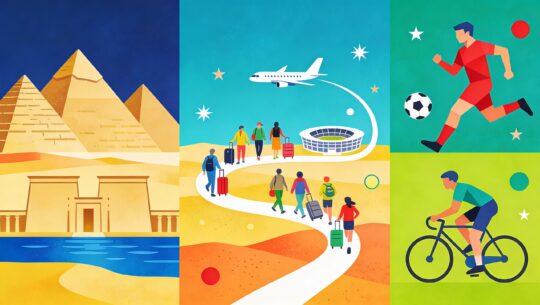
Egypt does not need to “invent” tourism. We are blessed with history, geography, and a cultural presence that the world already recognizes. Yet, while working in sports management, I became increasingly convinced that there is one powerful opportunity we still underuse: sports tourism—not as a seasonal side activity, but as a strategic engine for national promotion, economic movement, and a more diversified tourism product.
This conviction is what led me to write my scientific paper on modern trends and their impact on sports tourism marketing in Egypt. In this blog article, I want to highlight the paper in a humane but academically grounded way, share the journey behind it, and explain why the findings matter not only for sports organizations, but also for tourism authorities, event companies, media, local communities, and every young professional hoping to build a career in the growing intersection between sport and tourism.
Sports tourism is often misunderstood as “fans traveling to watch a match.” In reality, it is wider: it includes participation events, training camps, recreational sport travel, major competitions, and even wellness-oriented sport activity that connects directly to tourism experiences. What makes sports tourism especially valuable is that it links two emotional drivers: the desire to travel and the desire to belong to an event or an experience.
While reviewing sources and collecting the study material, it became clear that the world is moving toward new patterns in tourism marketing—driven by digital media, changing traveler expectations, and stronger competition between destinations. Egypt cannot rely only on traditional marketing methods if it wants to compete in this environment. Sport events, sport experiences, and sport identity can become part of Egypt’s tourism brand in a way that is modern, measurable, and internationally attractive.
This research was designed to answer a practical question: How do modern trends influence sports tourism marketing in Egypt, and what should institutions do to benefit from them?
The paper is built on a structured research design (with clear instrument testing and statistical processing) and a field study applied over a defined period in 2016. The work relies on a questionnaire that went through scientific coefficient testing (validity and reliability indicators are presented in the study), because any recommendations about “marketing strategy” must be based on credible measurement—not personal impressions.
Even from the numerical structure shown in the paper, it is clear the study used a sizable field sample (the tables show a total of 166 in the main application, with additional groups referenced in the methodology section), which provided a broad base for analyzing views and identifying statistically significant patterns across multiple axes.
What I personally found challenging about this topic is that many people love to talk about tourism marketing, but fewer people measure it. Sport tourism is full of enthusiasm—“let’s host events,” “let’s attract visitors”—but enthusiasm does not automatically produce sustainable results.
So I approached the paper like a bridge between two worlds:
The sports management world, where success is often measured in performance, participation, and organization.
The tourism marketing world, where success is measured in demand generation, destination image, visitor satisfaction, and economic impact.
To connect these worlds, I needed to focus on what modern trends actually mean in practice: digital behavior, communication channels, event packaging, partnership models, and the ability to turn a sports activity into a tourism experience that visitors can discover, trust, and purchase.
The study’s statistical tables reflect this logic. Many items show high levels of agreement and strong approval rates in the sample, with statistically significant chi-square values across axes, indicating that respondents recognize the importance of modern marketing approaches and their role in improving sports tourism promotion. At the same time, the presence of items with lower agreement signals that not every aspect of modern trends is equally understood or equally implemented—meaning there is still a gap between awareness and practice.
The paper’s results show strong support across many statements related to modern marketing approaches, and this is important because it indicates readiness: the field recognizes that change is necessary. The study also reflects that effective sports tourism marketing is not one tool; it is a package of actions that must work together.
While the detailed statements are presented in the tables, the overall direction is clear: modern sports tourism marketing depends on strategic communication, the ability to design attractive sports tourism products, and the ability to deliver a professional visitor experience that matches what marketing promises.
The paper also includes references and examples from tourism and sports tourism literature (including sources on sport tourism development and event impacts), which reinforces the idea that sports tourism must be managed as a specialized field with its own planning logic, not as an improvised extension of sports activity or tourism promotion alone.
This work is aimed at multiple stakeholders—because sports tourism is an ecosystem:
Tourism authorities and destination marketers, who can use sport as a modern channel for destination branding and visitor attraction.
Sports federations and clubs, who can develop events and training programs into tourism products, generating revenue and increasing international visibility.
Event management companies, because sports tourism depends on professional event delivery, logistics, safety, and visitor satisfaction.
Media and digital marketing professionals, because modern trends demand strong online storytelling, content creation, and platform-based promotion.
Local communities and small businesses, because sports tourism brings economic activity to hotels, restaurants, transportation services, and local retail—especially when events are designed to extend visitor stay and spending.
From an economic perspective, sports tourism can support job creation and diversify tourism income sources. From a social perspective, it can strengthen national image and encourage youth participation in sport by connecting sport to international movement and visibility.
The research includes contextual indicators and references related to tourism trends and sports tourism, reflecting that tourism markets respond to broader shifts—economic, technological, and behavioral—and that these shifts influence how destinations compete. The field data also reflects that professionals recognize these shifts and see the need for updated marketing approaches.
For me, the real value of this paper is that it pushes sports tourism marketing beyond “promotion” into strategy: a coordinated approach that requires data, partnerships, professional execution, and continuous adaptation to modern trends.
I wrote this paper because I believe Egypt can tell a new story through sport—one that complements our historical tourism identity with a modern, dynamic, youth-driven image. Sports tourism is not only about visitors; it is also about confidence. It tells the world that Egypt is not only a place to look at the past, but also a place to experience energy, competition, wellness, and modern events.
If this research contributes to better planning, more professional marketing practice, and a stronger collaboration between sports and tourism institutions, then it has achieved its goal. Because when sport and tourism meet in a strategic way, the beneficiaries are not only organizations—they are communities, young professionals, and a nation that deserves to present itself to the world with both heritage and forward-looking ambition.
