In the world of institutions, the value of numbers lies not only in what they report, but also in the opportunities they reveal, the questions they raise, and the decisions they help us make. From this perspective, I do not see the 2026 World Scouting Membership Report as merely a statistical document recording membership figures around the world. Rather, I see it as an opportunity to reassess the reality of Arab Scouting, examine its growth potential and institutional effectiveness, and evaluate how successfully it is translating its human potential into a sustainable educational and community presence.
Read the full report:
https://treehouse.scout.org/book-page/2026-world-scouting-membership-key-insights
Without examining every global indicator in the report, I would like to focus on the Arab Scout Region, beginning with a question that I believe is far more important than simply knowing how many members we have:
How significant is the opportunity available to Arab Scouting, and why has this potential not yet translated into a broader and more sustainable membership base?
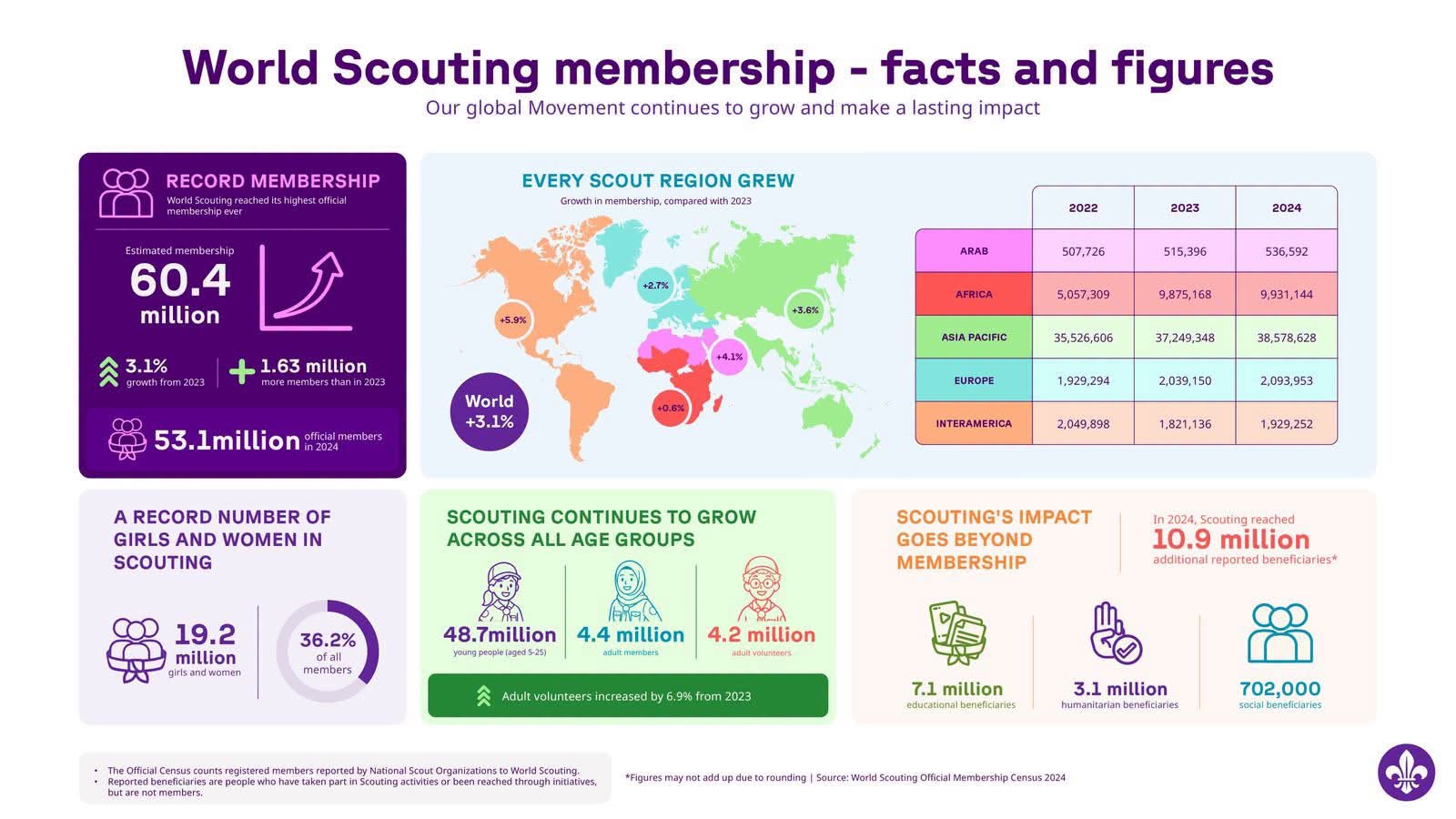
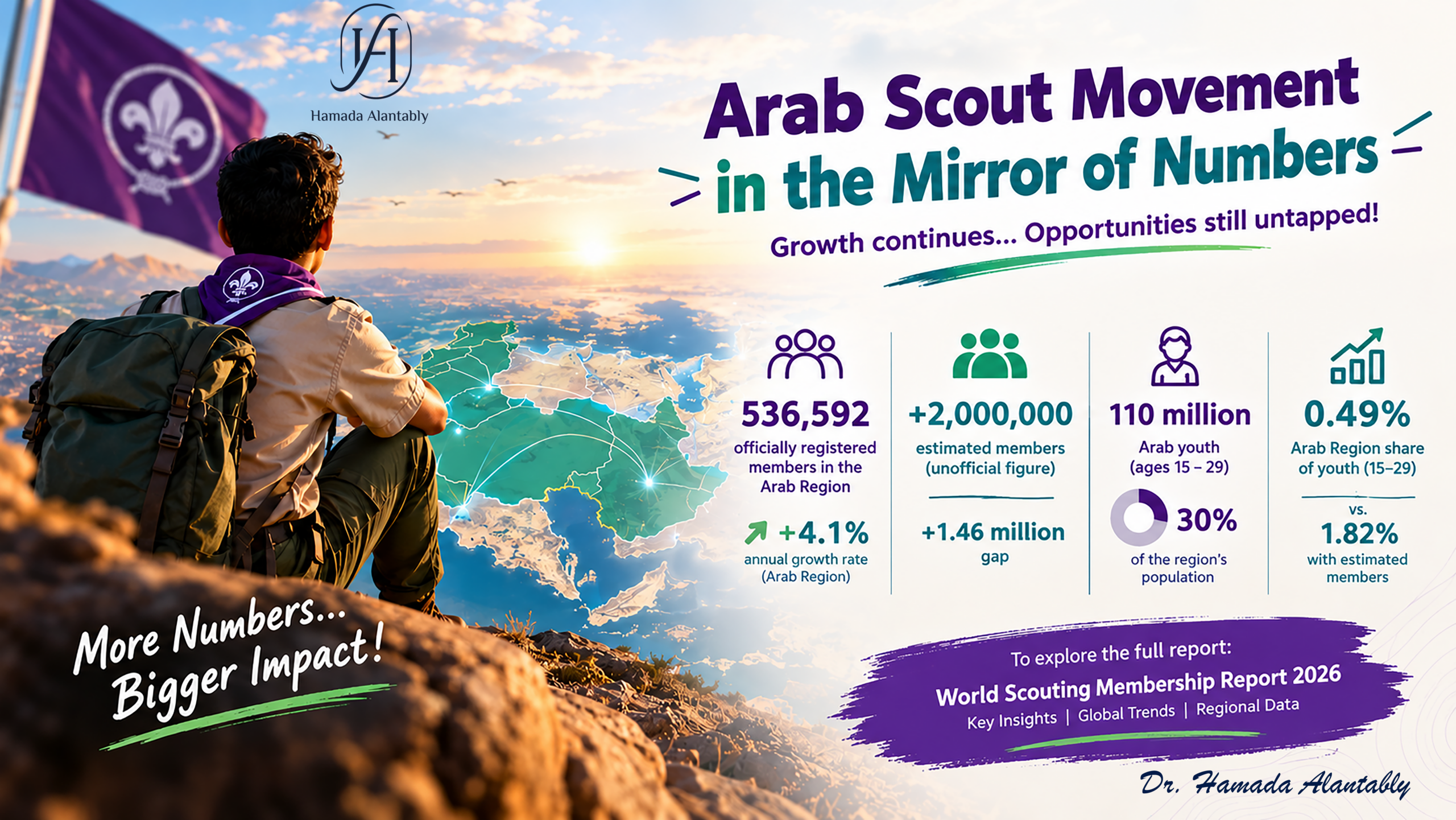
According to the 2026 World Scouting Membership Report, the Arab Scout Region recorded 536,592 officially registered members, representing annual growth of 4.1%, compared with 3.1% globally. This is undoubtedly a positive indicator, reflecting an increase in officially reported membership. However, the figure alone is not enough to assess the Movement’s current position or future prospects.
Despite this growth, the Arab Scout Region remains the smallest of the five World Scouting regions in terms of officially reported membership, with a considerable gap separating it from the others. This becomes particularly significant when viewed in a broader context: the Arab world has a large and youthful population, alongside growing needs for skills development, leadership, citizenship, and volunteering—all areas that align closely with the educational mission of Scouting.
Despite its relatively small membership base, the Arab Scout Region ranks third among the five regions in reported growth during the period covered by the report, following the Americas and Asia-Pacific. However, we must distinguish between three different measures: total membership, percentage growth, and the actual numerical increase in members. Relative growth alone does not reveal the scale of the increase in absolute numbers, just as regional rankings do not, in themselves, explain the reasons behind the differences.
Nor should low officially reported membership automatically be interpreted as evidence of weak public interest. Several factors may influence these figures, including the reach of Scout groups, the effectiveness of recruitment and retention, the availability of qualified adult leaders, programme quality, and the institutional capacity to register members and report accurate data.
Our objective should not simply be to compete with other regions on numbers. It should be to understand how they have expanded their membership bases, learn from their experiences, and adapt relevant lessons to the particular circumstances of Arab societies.
One of the most thought-provoking issues surrounding Arab Scouting membership is the discrepancy between official figures and unofficial estimates. Some unofficial estimates suggest that the Arab Scout Region may have more than two million members, compared with the officially reported figure of 536,592.
If these estimates prove accurate, the difference would exceed 1.46 million members, with the estimated total representing more than 3.7 times the officially reported membership.
What might explain this gap? One possibility worth investigating is whether concerns about membership-based subscription fees influence some National Scout Organizations’ willingness to report their full membership figures. However, this remains a hypothesis that requires evidence, not an established explanation. Other factors may also be involved, including weaknesses in registration and updating systems, incomplete data from local Scout groups and units, administrative or institutional constraints, and differences in how membership is defined and counted.
Challenges related to data accuracy and reporting, incomplete digital registration systems, and inconsistent membership definitions may all contribute to an incomplete picture of the Movement’s actual size. Nevertheless, determining the extent to which these factors affect the Arab Scout Region requires a systematic review of national membership data and reporting procedures.
The issue, therefore, is not simply which figure is larger, but which figure most accurately reflects reality—and what explains the gap between them.
Establishing a reliable estimate of the size of Arab Scouting is not merely a statistical exercise. It is essential for strategic planning, identifying needs, allocating resources, evaluating performance, and developing realistic policies for expansion and sustainability. An organization that does not know the true size of its membership base will struggle to assess the opportunities available to it or objectively measure progress towards its goals.
According to data published by the United Nations Development Programme in 2025, the Arab region is home to more than 110 million young people aged 15–29, representing approximately 30% of its population.
Against this demographic backdrop, we need to reconsider the position of Scouting within Arab societies. Comparing the officially reported membership of 536,592 with this youth population produces a simple ratio of approximately 0.49%. Using the unofficial estimate of two million members would raise that ratio to around 1.82%.
These figures are illustrative comparisons, not precise measures of Scouting’s market share. The youth population cited covers a specific age range, while Scout membership may include age groups beyond it. Nevertheless, the comparison highlights the scale of the potential audience and the importance of examining how effectively National Scout Organizations are reaching young people.
It also raises a critical strategic question: How can Arab Scouting engage a broader segment of young people and offer an experience that is attractive enough for them to join—and valuable enough for them to stay?
Young people are not merely numbers to be recruited in order to increase membership. They are the heart of the Scout Movement, partners in shaping its future, and potential leaders in their communities.
Expanding membership, therefore, cannot rely on traditional recruitment methods alone. It requires programmes that respond to the aspirations of new generations, stronger partnerships with schools, universities, and community institutions, and the effective use of digital technologies for recruitment, communication, and membership management. Above all, it requires a Scout experience that gives young people genuine opportunities to take initiative, participate in decision-making, lead projects, and acquire skills that support their personal, professional, and community development.
The real challenge is not simply having a large youth population. It is offering that population a Scouting experience worth joining and continuing.
One common mistake in institutional performance assessment is reducing success to a single indicator, regardless of its importance. Within Scouting, membership growth is a positive measure, but it cannot independently determine the quality of the educational experience or the sustainability of the organization.
What is the value of increasing membership if the number of qualified leaders does not grow accordingly? What is gained by recruiting new members if they are not offered regular programmes, a safe environment, and meaningful opportunities to develop and remain active?
Growth that is not supported by institutional capacity can become a burden rather than an opportunity. It may undermine programme quality, place additional pressure on volunteers, and weaken Scout groups’ ability to retain their members.
For this reason, I believe that assessing membership across the Arab region requires more than looking at total numbers and growth rates. It should include a set of interconnected indicators, such as:
It is equally important to distinguish between registered members, participants in activities, and beneficiaries of community programmes. These are different indicators, each with its own significance. Combining them into a single figure can create a misleading impression of membership size.
A strong Scout Movement is not necessarily the one with the largest membership alone. It is one that can grow while maintaining the quality of its programmes, managing resources efficiently, and delivering measurable and verifiable impact.
The equation we need to solve is not simply how to increase membership, but how to balance the expansion of our membership base with the quality of the Scouting experience and the institutional capacity required to sustain it.
A potential gap between official figures and unofficial estimates should not be a reason to stop at questioning the numbers. It should be a starting point for a systematic review of membership across the Arab Scout Region.
In this context, I would like to highlight an analytical study of membership data and indicators across Arab National Scout Organizations that I helped prepare and present at the Arab Regional Conference on Membership Development in 2021. The study examined membership across different Scout age sections, considered unofficial estimates, compared existing membership figures with the potential audience available to National Scout Organizations, and produced a set of findings and recommendations.
I do not know whether the study’s findings and recommendations were subsequently used. However, I believe there is a strong case for conducting a similar analytical review using the data presented in the 2026 report.
Such an initiative should not simply reproduce an earlier study or update a few tables. Its real purpose should be to turn existing knowledge into a practical tool for institutional decision-making and long-term development.
One important step would be to establish a regional Scout membership dashboard that enables National Scout Organizations to monitor membership trends, recruitment and retention rates, the sustainability of Scout groups, the availability of qualified leaders, girls’ and women’s participation, data quality, and community impact.
For this system to be effective, it would need standardized indicator definitions, clear data-validation procedures, and regular reviews of results, while taking into account the different circumstances and capacities of National Scout Organizations.
Most importantly, the data should guide the identification of each organization’s specific needs and the provision of appropriate support. An organization that needs to improve its registration system may not be the same organization that needs to train more adult leaders, modernize its programmes, or strengthen member retention.
The objective is not merely to know our numbers more accurately. It is to use that knowledge to make better decisions and turn challenges into genuine opportunities for development.
The Future of Arab Scouting Will Not Be Determined by Bigger Numbers Alone
The 2026 World Scouting Membership Report offers an important opportunity to rethink the position of the Arab Scout Region—not only in comparison with other regions, but also in light of the human and community potential within Arab societies.
The reported growth rate of 4.1% is encouraging. However, it does not change the fact that officially registered membership remains limited in relation to the scale of the Arab youth population. Nor does it remove the need to investigate the possible gap between official figures and unofficial estimates.
In my view, the real value of this report lies not only in the figures it presents, but also in the questions it compels us to ask, the opportunity it creates to reassess our priorities, and the possibility of building on previous research to move from diagnosing challenges to developing sustainable institutional solutions.
We do not need bigger numbers merely to improve our ranking among the regions. Nor do we need new reports that repeat the same challenges without leading to tangible change. What we need is a clear vision, reliable data, and leaders capable of turning opportunities into plans, plans into results, and results into lasting impact on the lives of young people and their communities.
The question that should occupy us is not simply: How many Scouts are there in the Arab region? It is also:
How many young people have we not yet reached? How many opportunities have we left untapped? And what must we change to make Scouting more accessible, impactful, and sustainable?
This is where the real interpretation of the numbers begins—and where statistics become more than indicators: they become instruments for change.
The future of Arab Scouting will not be shaped by bigger numbers alone, but by its ability to understand its reality, mobilize its potential, address its challenges, and turn untapped opportunities into measurable and sustainable achievements.
Dr. Hamada Alantably