


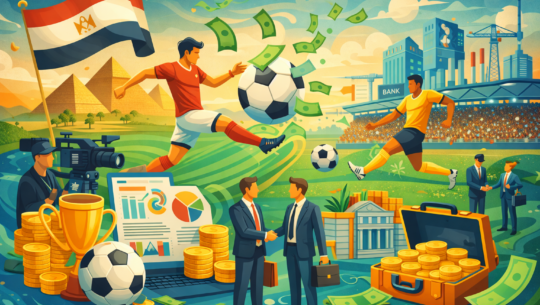
For a long time, I have carried a simple conviction: football is not only a game—it is an economic activity with real industries around it, real jobs depending on it, and real national value that can be developed if it is managed correctly. Yet, as I worked, observed, and spoke with people inside clubs and sports institutions, I kept encountering the same difficult question: if football in Egypt is already consuming resources like an industry, why are investment decisions around it still treated as if they were temporary solutions or personal judgments?
This is the question that pushed me to write my scientific paper, “The Role of the Football Companies in Supporting Investment Decisions in the Sports Field.” In this blog post, I want to step away from the formal tone of the research document and speak directly—person to person—about what the paper is really trying to achieve, how the journey of writing it shaped my thinking, and why I believe it has implications for industries and people far beyond the boundaries of stadiums and club offices.
The core issue is not that Egyptian football lacks popularity. On the contrary, it has a powerful mass base, cultural influence, and emotional value that most industries would dream of having. The issue is that popularity alone does not build sustainability. Professional football requires predictable income, structured spending, and strong governance mechanisms, because professionalism is not just paying players more—it is a system with conditions, contracts, continuity, and financial accountability.
As I explored this topic, I found myself returning again and again to the same comparison the paper discusses: many global football models treat clubs as profit-oriented companies, often specialized in football, operating under professional management and legal frameworks that protect rights, brands, and revenue streams. Meanwhile, in Egypt, clubs often carry multiple sports and social obligations, and football spending becomes a heavy burden without enough stable sources of funding to match it. The research text even raises the uncomfortable question in a direct way: are we dealing with a “winning or losing game” when clubs spend heavily but cannot generate the resources to sustain professionalism?
When I designed the paper, I did not want it to be an abstract discussion of “sports economics.” I wanted it to be a practical map for decision-makers. That is why the study set out to identify four main dimensions:
The activities and functions football companies could perform to support investment decisions in Egyptian sports.
The types of club investments that could provide funding sources to support professionalism and sponsorship in football.
The sources of information football companies could rely on to support investment decisions.
The challenges that could reduce the effectiveness of football companies in playing this role in Egypt.
In short: I wanted to clarify what football companies can do, what clubs can build, what information systems can support, and what obstacles must be removed.
In the paper, you will see a clear methodology: I used the descriptive survey approach because it fits the nature of the problem. But behind that technical sentence is a very human experience: listening.
The sample was intentionally diverse, because investment decisions in sport are never shaped by one group alone. I included employees from sports club departments and leadership positions—board members, executive managers, activity managers, and staff from marketing, investment, and financial management departments—across clubs such as Misr Lel-Makkasa, PetroSport, Goldi, Wadi Degla, MVB, and Al-Ahly. I also included staff from the Olympic Committee, the National Sports Council, and the Egyptian Football Association, along with investors and businessmen in sport, plus football experts and media specialists, reaching a total of 187 participants.
Designing the questionnaire was not a mechanical step. It required real attention to clarity, relevance, and credibility. The instrument was reviewed by experts in sports management (7 experts), and I verified validity and reliability through internal consistency measures and Cronbach’s alpha values across the axes (reported in the paper in the range of approximately 0.87 to 0.93). The basic study was carried out through personal interviews over a defined period in 2017, followed by statistical analysis using averages, standard deviations, percentages, correlation, t-tests, and chi-square.
I still remember how the process reinforced one truth: stakeholders may disagree on details, but they often agree on the main pain points—especially when the questions touch legislation, governance, and funding stability.
If one finding deserves to be placed at the front of every discussion about football investment in Egypt, it is this: many respondents strongly agreed that current laws and regulations do not provide the opportunity for football companies to play their role in supporting investment decisions in Egyptian sport. This is not a small technical issue; it is the foundation. If legislation does not allow football companies to form and operate effectively, then even the best marketing plans and the most enthusiastic investors will face structural barriers.
Another major message was the importance of sponsorship at a national scale. The paper highlights the need to encourage major commercial and investment companies, as well as major government organizations, to sponsor football teams and competitive championships. This matters because sponsorship is not merely “support”—it can function as a long-term partnership that brings capital, credibility, and marketing power into the sports ecosystem when governance is clear.
The study also identified practical roles that football companies could perform in supporting investment decisions, such as preparing financial indicator studies that motivate customers to invest, producing basic financial information for investors, creating specialized committees to study customer needs, and providing written reports that clarify return, risk, and the investment decision. These are not theoretical “nice-to-have” functions; they are the building blocks of confidence in any investment environment.
On the club side, the paper points to investments that can sustain professionalism: searching for sponsors for sports and social activities, offering advantages to sponsors to attract more of them, monetizing club logos and colors through products, and treating football as an investment project managed with economic thinking to achieve profits. Taken together, these results point toward an important conclusion: Egyptian football does not lack assets—it lacks the structured mechanisms that turn assets into sustainable revenue.
When people hear “football companies,” they may think the topic is limited to sports administrators. I disagree. This research speaks to several industries and groups:
Investors and business leaders, because the paper clarifies what information sources are considered useful (such as direct contacts with investors, annual reports, decision support bulletins, stock exchange bulletins, brokering companies, and bank economic publications) and what mechanisms can increase confidence in decision-making.
Marketing, advertising, and manufacturing sectors, because monetizing club brands through products, logos, colors, and merchandise implies supply chains, production partnerships, and retail strategies—not just “fan items”.
Media and broadcasting ecosystems, because professional football economics globally depends heavily on broadcasting and commercial rights, and the research discussion highlights how these revenue channels shape the sustainability of clubs and competitions.
Policy-makers and regulators, because the strongest obstacles identified relate to the legal and institutional environment, and without reform, many improvements remain temporary.
Athletes, staff, and fans, because professionalism affects livelihoods, work stability, club services, and the long-term strength of the institutions people emotionally attach to.
In other words, the “impact” of this work is not limited to club budgets. It is about building a healthier sports economy—one that creates jobs, attracts investment, and protects the dignity of professionalism through governance and sustainability.
The recommendations in the paper were written to be actionable. Among them, I emphasized the need for a stable phased strategy for establishing football companies in Egypt that does not change with changes in federation boards. I also recommended amending the Sports Bodies Act to include administrative, financing, structural, investment, marketing, and professional aspects, while providing a clearer pathway for establishing and managing football companies and enabling sports investment.
Other recommendations focus on learning from European club economic experiences, ensuring football companies have sufficiently large capital (as joint stock companies with shares offered for public subscription), strengthening the marketing function through an independent department, and building modern, effective information systems that provide accurate information to stakeholders at the right time. Finally, I stressed awareness-building through guidance materials that explain investment purposes, channels, returns, risks, and the role of stock exchanges and football companies in sports investment.
Academic writing is often presented as if it is emotionless. But this paper was never emotionless. It was driven by concern, responsibility, and hope: concern because the current model risks exhausting clubs financially, responsibility because researchers should address real national problems, and hope because Egypt has the popularity, talent, and market size to build a stronger sports economy if the environment supports it.
If this work encourages one serious step—one policy reform, one club strategy shift, one investor gaining confidence because information is finally systematic—then it has done its job. Football deserves professional management not because it is entertainment, but because it is an industry with people behind it, and every industry deserves a system that protects its future.
